Episode Transcript
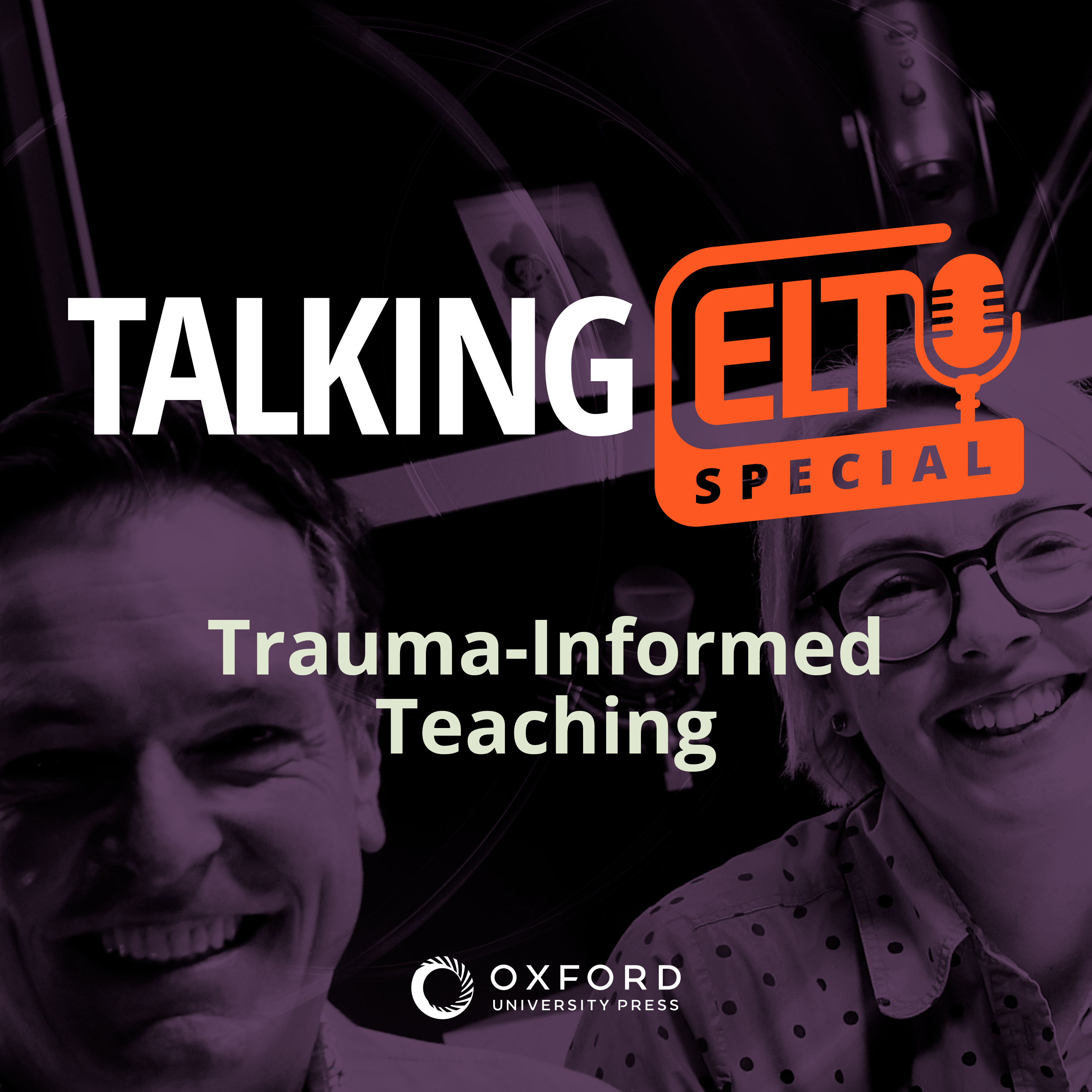
[00:00:07] Speaker A: Welcome to this special episode of Talking elt. I'm joined by Hayo Reinders and Auscholia Dunn for a fascinating conversation about trauma informed teaching.
[00:00:18] Speaker B: Trauma is a universal experience. It's something that, you know, if you think about adversity, that's a central aspect of any human being's life.
[00:00:28] Speaker A: Together we explore what trauma informed teaching actually means.
[00:00:33] Speaker C: I'll start by saying be careful not to be too careful.
[00:00:35] Speaker B: We need to see behavior as a
[00:00:38] Speaker A: communication of need, why it matters for all learners.
[00:00:42] Speaker C: If you care, people will notice.
[00:00:45] Speaker B: I wanted to be a better teacher and then I ended up being just a better friend.
[00:00:50] Speaker A: And how small changes in the way we think about teaching can have a big impact on creating safe, inclusive and supportive classrooms.
Hi, I think we've got a really interesting, really important podcast today. It's about a theme which not everybody knows a lot about. I certainly don't know a lot about it, but fortunately I've got two experts with me. So this is the theme of trauma informed teaching. And the two experts I've got with me are Professor Haier Reindus, who is also the author of the Oxford paper, a related subject which is supporting the teaching of refugee learners in English language teaching.
And we have. Ursula Dunn, who is a lecturer and teacher trainer in Ayrshire, Scotland, has come all the way down to Oxford. Thank you very much.
Sorry, I should have said Professor Reinders hijo has come from New Zealand, so actually. Yeah, yeah, he trumps us.
[00:02:02] Speaker B: I took the train from El.
[00:02:04] Speaker A: Yeah.
So come a long way. We've scoured the globe to find our experts and we've got. I've got my set of questions because I know so little and I'm going to kind of interrogate you relentlessly until I get the answers, which I need to understand, which I hope will be useful and inspiring to our listeners.
But first of all, I just want to get a sense of your personal connection to this subject. What is it that made you interested in this, in this subject? What brought you personally to this topic?
Ursula, should we start with you?
[00:02:37] Speaker B: Yes.
So our learner cohort at the college changed about five, six years ago. We started getting more students from refugee and asylum seeker backgrounds and I realized that I knew very little about wellbeing, so I made it my mission to find out more. And I knew so little about trauma that I didn't even realise that that's what I needed more information on. So through my research and reading well Being, I stumbled upon trauma and it just started to explain not just things that were happening in the classroom, but actually started to explain things that were happening to me in life, you know.
So, yeah, I wanted to be a better teacher, but then I ended up being just a better. A better friend, a better family member.
[00:03:26] Speaker A: Fantastic.
[00:03:27] Speaker C: And Haya, it's actually working with refugees is what got me into teaching. It wasn't my intention at all, but back when I was a student, I was studying Arabic and Hebrew. That's my background. And I lived and spent time in Cairo and later in Syria and Damascus. And while I was doing my studies in Holland, there was an organization, local organization, called educas. And they provide sort of language and kind of support and a friendly sort of connection to, you know, locals for people who had recently moved to the country. And I sort of started working with people who had an Arabic language background, you know, obviously, because that would benefit me as well.
And I realized, like, wow, this is amazing, because not only do I really love working with these people, but also it just made me realize that there is so much more to the individuals, to their stories, to their lives, than what the word refugee at that time sort of meant to me. And that fascination has always sort of stayed with me.
[00:04:27] Speaker A: Right. How interesting.
I mean, both of you have talked about refugees as almost being your starting point with this, but can we kind of get a fuller sense of the scope of what we're talking about? Because there may be listeners, teachers, educators who say, well, we don't really have that many refugees in our school. Maybe it's not for me, but I think this is actually a broader theme. So we talk about trauma experienced learners, I think.
Who are we talking about here?
What do we mean by that term?
[00:05:03] Speaker B: Trauma is a universal experience.
It's something that, you know, if you think about adversity, that's a central aspect of any human being's lives. We're all, you know, we all go through adversity at some point in our lives.
So trauma informed practice means that we recognize the impact of trauma, we realize how big that impact is, we respond to trauma, impacted learners needs, and then we actively resist retraumatization.
But trauma informed practice is good for everyone in any class, not just for learners who have experienced trauma.
[00:05:45] Speaker A: Right, yeah.
[00:05:46] Speaker C: And just to add to that, I think there's two sides to that coin. There's trauma informed teaching, as in understanding trauma, being able to recognize and be able to respond to it, but also recognizing your own trauma, your own adversity, and being able to connect with others on that basis.
[00:06:03] Speaker A: Yeah.
Can I just explore slightly that thing of Adversity and trauma. Because trauma is a really strong word and there must be degrees here.
How do I think? Well, I don't know if I know my students have got adversity, but is a trauma informed approach the right thing? Because you just said also that actually it's for everybody. So I'm trying to. I'm trying to gauge that question.
[00:06:31] Speaker B: Yeah, it's very difficult to capture because trauma is not so much. It's not so much the event or the circumstances.
It is very much in terms of the response of the individual to that event.
And the variables are, you know, there are so many variables. What applies to me will not apply to another person. What I might find traumatic at one stage in my life, I might not find traumatic, you know, later on, 10 years later.
So, you know, there are many, many, many factors influencing how somebody experiences, experiences an event or a set of circumstances.
So what we say today will not necessarily apply to every person who is impacted by trauma.
[00:07:18] Speaker C: Yeah, I guess what your question points to, correct me if I'm wrong, is that, you know, we use this word, and it does have a certain set of connotations, and obviously we use that word deliberately. You know, we don't say, oh, I had a trauma today, if you've just had a minor, you know, hiccup.
So I think there. It is important to recognize that, you know, there is a line between pathologizing, shall we say, negative or adverse experiences and responding to such experiences, either your own or others, as if it is, you know, as a pathology, as a disease to be fixed.
But of course, there are recognizable stages and levels of trauma that people have experienced. And we also know that there are significantly different impacts that experiencing one or more, as you yourself describe it, traumatic experiences in your life, on your further life development and your. Your journey. So there is a sort of a, shall we say, almost medical literature or psychological literature as well. But I think here we're talking more about sort of the experiences that learners and teachers bring to the classroom.
[00:08:30] Speaker B: Yeah, yeah, yeah. It's very important to say that we're not like, I am not a clinician, you know, so everything I say today is in the context of education.
And I think teachers, whether they teach refugees or not, you know, in any classroom, are confronted with the impact of trauma because it's so prevalent, you know, in different societies and countries.
[00:08:53] Speaker A: When you were speaking before, it really kind of landed with me when you said it's not the event, because I know people in this country who have felt traumatized by racism and people Kind of challenge them so what actually happened? And they want to draw out to them that they were beaten up. And they say, no, it's not an action like that.
It can be things which on the surface, don't sound that dramatic, but they have an impact on you.
[00:09:20] Speaker B: Yeah, yeah. And it's something that overwhelms you, and you're unable to respond in ways that are autonomous and in ways that you feel in control.
So trauma will have a huge impact on all dimensions of our functioning. You know, physical, psychological, emotional, spiritual. It impacts everything.
Everything. Who we are and that and what we understand about the world.
[00:09:45] Speaker C: Yep. I think that that is a really helpful word, that sense of agency, you know, losing agency, or if you recognize that in yourself or in others, I think that's a telltale sign, because that's where you feel, as you say, overwhelmed. And you're not able to regulate how you would like to respond because you don't have that ability anymore, and you
[00:10:04] Speaker B: lose your connection with meaning.
You're no longer able to explain the world the way you were able to explain it before the event.
You know, those meanings no longer hold the center.
[00:10:16] Speaker C: Things have shifted.
[00:10:18] Speaker B: Yeah, yeah, yeah. And your sense of self has changed as well.
[00:10:20] Speaker A: Like the rug being pulled out from under your feet.
[00:10:23] Speaker B: Yes, yes.
[00:10:24] Speaker A: Sensation.
[00:10:24] Speaker B: Yes, absolutely.
[00:10:26] Speaker A: Yeah. I mean, one. The question which I had to follow up on that was, what are some of the emotional, psychological, and educational challenges? This is a big question that these learners bring with them into the language classroom. I think we're kind of thinking this in the language area.
[00:10:42] Speaker C: You've mentioned a few before, Orshi. I think one that I'd like to highlight is developmental, especially with younger learners, you know, trauma. One way of looking at it is a level of stress and a duration of stress that the system just can't handle. And it has a real impact on even our cognitive development.
So we know, for example, that children who have had three or more critical experiences during their growing up are less likely to develop hippocampal memory formations. They're less likely to develop executive, prefrontal cortex, executive functioning, which, of course, is. These are the things that you need for learning a language. Right. To read, to acquire vocabulary. So there's. There's that aspect.
[00:11:34] Speaker B: Yeah, yeah, yeah. So trauma basically interferes with your capacity to process information and to recall information.
So that's attention and memory. Yes. And your communicative functions are impacted. Lexis grammar is impacted. So basically, it really sets you up for a bumpy ride in the language classroom.
[00:11:57] Speaker A: Could you just kind of Bring, clarify or bring that to life a little bit. When you talk about your communication or communicative functions might be impacted.
How might we see that?
[00:12:07] Speaker B: Yeah, so you mentioned the prefrontal cortex. You know, that's the adult in the room.
It's responsible for making, you know, for making rational decisions, long term planning and so on. And the hypothesis, hippocampus sorts out the past and the present, you know, so your memory is impacted.
But what happens is that the prefrontal cortex is very often not able to be present at the time of learning.
And your behavioral stress responses are activated and can be activated an awful lot. So the way, for example, Bruce Perry characterizes learning for a trauma impacted person is that kind of low level simmering fear that can stop curiosity and eventually stop learning. Because if you're hyper vigilant. So if you're, if you're scanning the room for threats. Yeah, because something triggered it. And it can be something very, very, very minute, something that, you know, you and I would not think of as a, as a trigger.
But trauma impacted learners can, can be hypervigilant. And when you're hypervigilant, basically your brain is focusing on future threat, so learning cannot take place.
[00:13:24] Speaker A: And the communicating, I can see that point because communicating is kind of exposing your vulnerability because you can't phrase things. You're trying to connect with people. But if your, if your emotional state is not wanting to connect.
[00:13:39] Speaker B: Yeah, I mean, you cannot connect because your brain is focused on survival. Your brain is looking at, okay, are you a friend or a foe? And it's not listening because it cannot process language. Words don't matter really, because the words don't go through. What a learner will focus on is your face, your tone of voice, your posture, not what you're saying. You know, so big long explanations don't really work with a learner who's having a fear alarm reaction. It's your, you know, it's your state of calm that will trigger those mirror neurons.
[00:14:13] Speaker C: Yeah. As a teacher, the way that, that might manifest itself in the classroom that would allow you to notice that is, you know, the term willingness to communicate is helpful here because it may appear that the learner is simply unwilling to participate. Or, you know, they're just not, they're just not trying, you know, but, or she said they, they can't try in a way because there's just no capacity to do that. Another way that it can manife through hypersensitivity. So you have learners who, as you said, they're, you know, subconsciously scanning the room for. For threats. And then if someone does or says, or even doesn't say or doesn't do something that they should have done, you experience that and interpret that perhaps you know, from that. From that space. So you then sometimes have learners who respond in ways that the teacher might immediately recognize or think to recognize as, you know, disruptive behavior or.
[00:15:10] Speaker B: Right, yeah, yeah, yeah. When. When it's just a fear alarm reaction. And. And the problem with that is that it brings about a cascade of misinterpretations.
[00:15:19] Speaker A: Yeah.
[00:15:20] Speaker B: Everybody misunderstands each other in that interaction.
So we need to see behavior as a communication of need.
Trauma informed teaching asks us to flip our understanding of human behavior to really think about the whys.
[00:15:38] Speaker A: Behavior is a communication of need. Okay, that's a great. That's a great kind of summary of that point. Fantastic. And what you've done naturally here is to move into this next set of questions that I wanted to ask you was, so what does this mean for the teacher? How do teachers respond? I think my first question was going to be, in your experience, what are the kind of things that teachers might kind of get wrong, might misunderstand or misinterpret, make wrong assumptions.
So if, you know, if there are teachers out there, what could we say? Be careful of making this assumption?
[00:16:18] Speaker C: Well, I mean, I know you have a lot of practical examples which I think will be very beneficial. I'll start by saying, be careful not to be too careful.
[00:16:26] Speaker A: Okay.
[00:16:27] Speaker C: Because there is a lot of, I think, some anxiety that teachers carry, like, what if I say the wrong thing? What if I do the. What if I, you know, refer to this person in the wrong way, and I think at least having the willingness and the courage to open yourself up and question your, you know, your teaching practices and your communicative behaviors and so on, I think that's a great starting point. So let's just get that out of the way. Not doing anything and not trying, that's the only sort of thing that you should avoid.
[00:16:56] Speaker B: Yeah, I think you're spot on there. Kindness and openness and a willingness to be there. And people sense that, you know, and that will strengthen their sense of safety. So first and foremost, if you want to do anything, make sure that people feel physically, emotionally, and psychologically safe in the space where you're at. But I remember I always used to think that it is, you know, that these incidents or sticky situations came about because I've done something I always, before I knew what I know now, I always thought, oh, it's about me. Yeah. I am not inadequate as a teacher. And then as I kept reading, I read something by Jessica Minihan, who offered this metaphor of a soda can or fizzy drinks can that really, really stuck with me. And she was saying, you know, imagine like, you have to be. You have to have an informed sense of preparedness for what is awaiting you in the classroom. And imagine, you know, you have a fizzy drinks can and you shake the can, you know, and something happens. You don't know what's inside the can. You don't know what shakes the can. You don't know how many times the can has been shaken.
All you know is that it went and you were there.
So having that kind of opening, openness to unpredictability, you know, having a sense of curiosity.
[00:18:27] Speaker A: Yeah.
[00:18:27] Speaker C: I wonder why there's this delightful term called confident uncertainty. I think it's Alan Langer, who talks about this in her book Mindfulness Teaching, Mindfulness Learning, which is a fantastic book. And actually, although it's not about this topic directly at all, I think holds a lot of important lessons. This idea of being being open and not having fixed assumptions and being willing to ask the why behind the why. So, you know, why is this learner not participating? Well, maybe they're, you know, whatever. And then why is that? And then why is that? And how does that relate to me? But being willing to be confidently uncertain by being okay with that.
[00:19:07] Speaker B: Yeah, yeah. And these dominant discourses that we have in teaching don't exactly encourage us to be confident of it, you know, because the myth is that everything that happen, happens in your room depends on the teacher. Well, it doesn't. I can't. How could it? You know, you have all those universes of one coming into the room. Everybody comes in with their own lived experiences and issues and histories and needs, and you really don't know. And there are 20, 30 of them. And then. Then you've got your own universe. Yeah. And if you're lucky, you know something about that. But maybe it's a lifetime journey, isn't it, to find out what is your universe of one about.
[00:19:51] Speaker A: Yes.
[00:19:52] Speaker B: So it's not easy. And I think we have to be honest about that. You know, we have to kind of acknowledge certain feelings that go with teaching that are not necessarily encouraged to be expressed or acknowledged.
[00:20:04] Speaker A: Yeah.
[00:20:05] Speaker B: You know, like doubts and bewilderment and vulnerability. It's all very much part of your emotional kind of landscape in your page.
[00:20:16] Speaker A: Yeah. I mean, it's so. And see, now I have a picture of A classroom with cans, and you just don't know when you open them, whether it's been shaken a hundred times before or not. And if it's. If it does fizz everywhere, it's not you, as you say, it's been shaken before you even got into. They even got into that classroom.
[00:20:36] Speaker B: Yeah. And we need to have that curiosity to want to understand what, why, Why. I wonder why that has happened.
[00:20:43] Speaker A: Yeah.
[00:20:43] Speaker B: So that things don't escalate. Because this is when things escalate and people, you know, are either excluded or exclude themselves.
[00:20:52] Speaker A: Yeah. So we talked a little. I think you mentioned something about, you know, we need to create a classroom where it feels safe, compassionate.
What else would you say we should do to make a kind classroom? What does that mean in practice?
Was it difficult to pin it down?
[00:21:10] Speaker C: In some ways it is, but in some ways it's not. I mean, it's in some ways what a lot of us attempt to do anyway. But perhaps putting a little bit more time and thought and reflection into that and that openness that we've talked about observing, like, hey, if I do this, what happens? And then, oh, you know, how about this? How about that? Maybe I need to question some of my own assumptions about what should happen in the classroom or how it should happen.
I think another really important aspect there is maybe sometimes overlooked a little bit is the notion of structure.
Maybe this applies more to learners who are from a refugee background.
But I suppose that if you have a group of learners where perhaps there is a lot of collective trauma, that also will help. The idea that there is a degree of predictability and the unpredictability because things are unclear and there is uncertainty. But if there is some routine, if there is some expectations and if there is an attempt by the teacher to bring you into that routine, the group, you know, whatever that looks like, that turns out to be very helpful at a practical level. And that's something that all of us can be mindful of.
[00:22:24] Speaker B: Yeah, yeah, yeah, I agree with that. Routine and structure will keep people safe. That contributes to your sense of psychological safety. But also, I think agency is very important because trauma is often about loss of agency and loss of control. So trauma, impacted students will have a heightened sense of need for control. And giving them choices can be really, really empowering. And we can. We can try and give them choices in all sorts of ways. You know, in terms of what we learn about, how we learn, what kind of activities we do, what order we do them in, the optionality of participation, even talking to them about what participation will look like or can look like in this classroom. Also asking them, you know, what can I do to make you feel safe? Physically, emotionally, psychologically, and having these discussions from time to time, one to one, even as a group, because you don't have to frame it as well, you know, everybody, I'm trauma informed and you know, we're all going to be safe. No, it's my intrinsic value of listen so good that you're here to learn. I want this class to be safe and I want you to be valued and I want you to feel that you belong. And so how can I do that?
[00:23:45] Speaker C: Yeah, you know, yeah. And as a teacher, you can choose to adopt that level of agency yourself.
There is, of course, you know, there is a challenge there when you run up against, maybe we'll get to this later, but where you run up against systemic boundaries.
I don't know if this is a good time to move on to that aspect, but there is a lot that teachers can do, and we know this from, from action research and from various types of studies that have been carried out to become more, shall we say, attuned to trauma and more, you know, incorporate more trauma informed teaching practices.
And we know that if teachers are supported, whether through professional development or through a supportive environment or through colleagues who have more experience, that yeah, they can generally and do generally pick that up and are able to change their practices as a result.
But it's also quite clear, and there's a very interesting recent study. I think it was published last year by Gonzalez in, in New York.
And this was a study of 12 teachers who were receiving workshops from a professional organization on how to work with. I think it was refugees specifically. And in that study, what was found, yes, teachers very happy to change their practices and be more inclusive and so on.
But then of course there are things around assessment and there are things around deadlines and there are things and expectations around what should happen in the class and what shouldn't happen. And that's where sort of the tension arose. And I think that's an important element to look at.
[00:25:27] Speaker B: Yeah, yeah. I mean, adopting a trauma informed approach asks a lot of us, not just as individuals, but as a collective as well. Because unfortunately, our problem solving paradigm is very often individual based.
Trauma is viewed as an individual problem and the solution is encouraged as at an individual level, you know, at classroom level. But as you say, trauma is a social issue. You know, we're caught in this overwhelming web of interconnected, intergenerational social media problems that people experience as traumatic and so our solutions cannot be individual solutions, they have to be collective solutions.
[00:26:15] Speaker C: Before we carry on, I just want to quickly mention a really useful focus paper that I've authored for Oxford University Press. It's called Supporting a Primer for Language Teachers. It's written for teachers who might suddenly find themselves working with learners who have quite different needs and experiences and who may not have had specific training in this area.
The paper talks through some of the key challenges learners and teachers face, but it also looks at the positives and what these learners bring to the classroom. It then goes into practical teaching approaches as well as the wider support that schools and organizations can put in place to really help.
There are also resources and reflection prompts you can actually use in your own context.
And it's worth saying it goes into much more depth than we can in this episode. So if you want to explore these ideas further, it's definitely worth a look. You can download the full paper using the link in the description.
[00:27:21] Speaker A: If you are somewhere who has perhaps more responsibility within an organization or you're trying to talk to someone in a position of responsibility, what things should we be trying to highlight in order to create a better institutional approach to this subject? Where do we want to start?
[00:27:46] Speaker C: There's so much to say.
[00:27:50] Speaker B: Where do I begin?
[00:27:53] Speaker C: I mean, I'll speak to something that I have a particular interest in, which is teacher leadership. And I think that's an obvious starting point. Just this idea again of agency, but helping, supporting teachers in developing the ability to question, to criticize, to engage, to offer alternative solutions, to negotiate with the broader system, with the various stakeholders.
That to me is a very natural starting point. And that obviously begins at, you know, pre service training and through, you know, professional development. It's a never ending process.
[00:28:28] Speaker A: So that's part of the teacher development approaches to build that questioning mindset.
[00:28:36] Speaker C: Yeah, exactly. And having not just, you know, like develop the ability to be critical, but also having the practical tools to communicate that in a way that works within whatever system you operate within. Right. It's one thing to go out with a banner and say, you know, this school was terrible, but it's another to have a good conversation with your dean or your head of department. And yeah, and I think that's where a lot of teachers, and I know this from some of the research that I've done where teachers say, well, I have these ideas, I can see that this would be much better, but I don't know how to, you know, where to go and how to convince the powers that be that we should do this.
[00:29:12] Speaker B: Yeah, because we're asking a lot, really, you know, from our individuals and from our organizations, because it is a fundamental paradigm shift that we're asking for. You know, we're saying to people, well, what I need you to do is to forget all the things you believed in and all the ways you understood the world, you know, and now you need to have a new definition of human behavior, a new understanding of what sickness is, of what badness is, you know, and on you go.
So there are huge changes needed. You know, policy level, procedure level. You know, we need to understand that our methodologies can be detrimental to trauma, impacted students.
We need to understand that shame, for example, as a master emotion and is a fundamental, key, fun, key experience in the aftermath of trauma. And a lot of the things that we do in the classrooms and in our institutions can be shame inducing.
And human beings will do everything, everything in their might to run away from that feeling of either being shamed or feeling ashamed. Shame is so such a taboo. We don't even, you know, we don't often talk about shame in teaching.
[00:30:28] Speaker A: So again, just get my head around this. So are we talking about the assess, assessment and feedback? Is that.
[00:30:37] Speaker B: Yes, every level of functioning in an institution, you know, for example, how we. How we give feedback, how we display results, how we.
What we do at a diagnostic test, do we have people in for group interviews? You know, what kind of disclosure do we expect? Or do we. Can we even expect a disclosure?
[00:30:58] Speaker A: Yeah.
[00:30:59] Speaker C: You know, and even at the level of classroom activities, I mean, role plays can be wonderful, but they can also be incredibly challenging, like putting people on the spot, which is maybe more acceptable or common in certain cultures than in others.
And if you have a learner who is not from that culture.
[00:31:18] Speaker A: Yeah, yeah. And is that extending to all kind of collaborative tasks?
[00:31:25] Speaker B: I think what we need to kind of understand is we need to tread really carefully, for example, with personalization, as you mentioned, as in role play. Yeah, and role play. But in a role play, you have to imagine that you are something.
Some people might not be very comfortable with abstract thought, because that's one impact of the trauma. But also in role play, you might have to play yourself.
And. Yeah, so I think we really need to rethink some of the methodologies that we use.
[00:32:02] Speaker C: It taps into something that I just read a few weeks ago. It's a study by Hensman in Kanagajara of learners who had experienced significant trauma in, I think it was Sri Lanka. And one of the key findings from that study was that in that specific context, in that cultural milieu, the trauma that the learners had experienced was experienced by them as collective more than individual and as historical more than related to an event that happened yesterday. And that's an example I think of. That's a mind twist for, for me, when I was reading that, because to me, the idea of trauma is, you know, you, you get hit by a car and there's a traumatic event, and now I experience that. But obviously you mentioned earlier the social aspect and the broader context. Well, that's, that goes beyond the, the moment in time that's historical. That's.
[00:33:01] Speaker A: No, I can see. So in the role play, there's, there's a kind of identity question which you, which you're introducing there. I think my mind was shifting a little bit to collaboration and memory of someone talking about, particularly in secondary schools where the children or the teenagers in your class are all struggling with their relationships with each other.
And there's probably dominant figures, there's probably bullying going on amongst those different people.
And then you naively step into that and say, okay, you and you work together, you do this, you're the, you're the leader of this. And, and you're stepping into a minefield of relationships. And, and I'm thinking, yes, that's, that kind of extends to the kind of things you're talking about here. People are bringing lots of complicated relationships and experiences and emotions into what looks on the surface to us as an easy collaboration, working groups kind of thing.
[00:34:05] Speaker B: Yeah, I mean, it's a really tricky one because trauma will impact our ability to form and maintain trusting, reciprocal relationships. But the beautiful thing is that relationships are the ones that, or are the things that can be helpful in the healing process from trauma. And, you know, we have unique experiences or unique, unique, a unique potential in a classroom to reinstate some of those bonds and relationships.
But we need to tread carefully. We need to understand that people will have difficulties, for example, working in groups.
So the element of choice can be really helpful there. Who do you feel comfortable working with?
[00:34:53] Speaker A: So I was going to come back a little bit to when we were talking about at an institutional level and I was going to ask you to role play, not to role play.
I was going to ask you to imagine you are talking to a principal of a school and that principal says, actually, we don't have a problem with this. Everything's okay here. We don't need to do anything.
So what would be your questions to that principal to make them to think more deeply about this? What are the things that they might be overlooking. Sorry, this is a question.
I just came to the top of
[00:35:27] Speaker C: my head, so I would simply say, when was the last time you experienced something that was difficult? When did you last experience adversity?
Probably yesterday or last week. Right. Well, what did you learn from that?
Was it just a negative experience?
You know, was there perhaps something beneficial there? How do you think that has informed how you think about yourself? How the other person that was perhaps involved.
Wouldn't that be wonderful to bring that into our educational experience?
[00:35:57] Speaker A: Right.
[00:35:58] Speaker B: Yeah, yeah, yeah. What makes you feel safe? You know, we all have things that make us feel safe, yet we don't necessarily translate that into a classroom level or institutional level and ways of being. So, for example, I think we very often forget that our classrooms are not necessarily organized physically in ways that are conducive to feeling, having a sense of safety. So, for example, can you see the door?
For some people, for a lot of trauma impacted people, having to sit with their backs to the door can be incredibly challenging because they don't have clear sight lines. There's no escape.
So that immediately, immediately interferes with their cognitive functioning. That's a kind of low simmer.
Is the door open or closed? Can you see the windows? So that optionality. So, for example, the first thing I would say to my principal is, can we please have movable furniture? So that when I ask my students, what is it that makes you feel safe, you know, and they say, I really need to sit, you know, in a certain way, then I can accommodate that.
[00:37:09] Speaker A: Right, right.
[00:37:10] Speaker B: But if you have a room, you know, a computer lab where all the desks are around the walls and every single student is sitting with it with their backs to the door.
[00:37:21] Speaker A: Yeah.
[00:37:21] Speaker B: That's a powder keg.
[00:37:22] Speaker A: Yeah.
[00:37:23] Speaker B: You know, and so we have a very long way to go.
[00:37:27] Speaker C: It's that physical agency as well, like the ability to. To know as a. As a learner or teacher, indeed, that I can. I can move, I can get up, I can shift the situation if I need to, if I want to.
[00:37:40] Speaker A: Yeah. So that agency is a very clear message.
[00:37:43] Speaker B: Yeah.
[00:37:45] Speaker A: Mentioned earlier, assessment.
Is there anything that you might kind of check with the principal around Assessment? Have they thought about X, Y? Why?
[00:37:56] Speaker C: To me, the. The immediate starting point is, is, you know, we've talked. It's only been, what, 10 years or so that we've talked about the psychology of the language learner and that we're more comfortable. Not everyone, not all the time, but talking about emotions in language learning and teaching. And I think that's a helpful starting point, is where we say, look, we want our learners, all of them, whether trauma experienced or not, to become more resilient, to become more confident, to be able to deal with negative emotions and adversity. And I think for a lot of people who perhaps have some reluctance to engage with, you know, refugees and trauma, you know, that might be a little bit scary for them. If you talk about concepts like this, that's a very, I think, a very acceptable entry point.
[00:38:38] Speaker A: Right, That's a good idea.
[00:38:39] Speaker B: Yeah, yeah, yeah. And I mean, assessment can be very, very stress inducing, you know, even if you're not impacted by trauma. And we need to understand that diagnostic tests, even just to have an initial placement test for a trauma impacted student can be extremely triggering.
And so we're never going to get the kind of information that we need because the circumstances were not right.
[00:39:08] Speaker A: Yeah.
So that's. So you're not saying. I think I'm putting words into your mouth, but I think you're not saying don't need diagnostic assessment, but that you need to be aware that diagnostic assessment may not be effective in some circumstances.
[00:39:25] Speaker B: Yes. And we need to be careful in the way that we administer those assessments. You know, we need to. We can't. You know, some of our processes can be very, very triggering for learners who have had adverse experiences in an institutional setting.
[00:39:40] Speaker A: Yeah.
[00:39:41] Speaker C: We had students at my former place of work in New Zealand who were refugees and had come from Afghanistan.
And the first thing that we asked them to do, or the institution asks them to do is to fill out a long form with all their personal details, their home address and their, you know, whatever. And that's one of the scariest things you can ask a person who has had that, you know, happened to them for the purposes of, you know, whatever terrible things followed.
[00:40:08] Speaker A: Yeah, yeah.
[00:40:09] Speaker C: There's no reason why it has to be done in a written form. We can just talk to them.
[00:40:14] Speaker A: Yeah.
[00:40:15] Speaker C: And record it in some other way.
[00:40:17] Speaker A: Yeah, yeah, yeah. That's a good example.
I've got a question here, which I'm not sure. Well, let's see what answers you come up with. But it's, it's. What are some of the pushbacks you might get? So you're, as a teacher, you've listened to this podcast, you're inspired, and you go, what are the kind of pushbacks you might expect anticipate for trying to be more trauma informed?
[00:40:45] Speaker B: Yeah, I mean, I've referred to this, you know, this huge, huge request, you know, that we make of people like, from now on, you need to really just think about the world in a difficult way from the way you thought about it yesterday. So it can be quite overwhelming for people that initial.
Initial change or initial change of perspective. And, you know, we very often say that we need to meet our learners where they are at, but we also need to meet our colleagues where they're at. Not everybody is comfortable and ready, you know, in a specific moment in time.
For reading more about trauma informed practice.
It takes courage, it takes strength, because you have to also, you know, once you realize what the, you know, what the more kind of what the right ways of going about things are, you have to advocate and, you know, for your students and for your staff, fellow staff members to your institution, you know, and it takes so much energy, you know.
[00:41:58] Speaker C: Yeah. That idea of meeting, you know, not just your learners, but also your colleagues and your administrators and the broader context, the parents, the community, where they are at. I think that to me is a starting point that honors the other person.
Right. It's not judgmental. It's not like, well, you're not. You're not very trauma informed.
But, you know, you're here listening to me, which is great. So let's start there.
[00:42:27] Speaker B: Yeah. And we need to respect dissenting voices because trauma is a complex thing, and addressing trauma as a community is a very, very complex thing. So individual decisions are not necessarily better than collective group decisions. And we need to listen to the voice of dissent so that we are able to create a culture in the workplace where people feel that if they have something to say, even if it's counter, you know, if it's countering what the kind of accepted narrative and discourse is, they feel comfortable in sharing that so that. So that those dissenting voices will be listened to respectfully. And we can go from there. You know, it allows us to think about our practice.
[00:43:11] Speaker A: Yeah.
[00:43:11] Speaker B: Because there's nothing worse than getting too
[00:43:13] Speaker C: comfortable and also, you know, question our own assumptions because we may be, you know, 100% convinced that we're doing the right thing, and maybe we are, but maybe we're not. Maybe there's some nuance to that.
[00:43:26] Speaker B: Yeah, yeah. And a good example of that is translanguaging. So I've always, you know, I'm a great believer. And allowing Lear, not allowing any. Encouraging our learners to use their linguistic repertoires and to use their first or home languages as a cognitive scaffolding and learning and monolingual classrooms will have an impact on your sense of belonging and on your sense of self worth in the sense of what kind of knowledges count in the classroom?
And we think about translanguaging is a reconstitutive thing, you know, that it re establishes relationships and sense of self worth. But we also need to understand, and there's a caveat there, that for some people, trauma is associated with the first language. You know, there are very good studies out there on that that say that, you know, English can be, for some students, a symbol of new beginning.
You know, it can symbolize a sense of escape.
[00:44:36] Speaker A: Yes.
[00:44:37] Speaker B: So not every learner is comfortable in utilizing the resort their linguistic resources in their first language. We can't assume that. So I think attunement, you know, being really, you know, the universes, you know, all those universes colliding in the clash classroom.
[00:44:55] Speaker A: Yeah, right. Listening to your students. Wow.
[00:44:58] Speaker B: Yeah.
[00:44:59] Speaker A: Wow.
[00:45:00] Speaker B: Yes.
[00:45:00] Speaker A: Yeah. But, but you're right, it's the complexity, you think?
Because that, that's such a good point. Because I was thinking. Yeah, I can see the importance of bringing in your own language. But there is. Yeah. You have to be sensitive. That it's not necessarily an empowering thing. Yes.
[00:45:15] Speaker C: And also vice versa. You know, you might assume that using a particular language or avoiding a particular language is the right thing. But I think maybe the study you're referring to is the one by Sally Rachel Cook and Jean Mahdawal.
[00:45:26] Speaker A: Yeah.
[00:45:26] Speaker C: Where they found that actually these learners used the English language as a way of kind of regaining their agency. Here we go again. Regaining their agency and rebuilding their identity.
So, yeah, be careful what assumptions you make, even if they come from a
[00:45:40] Speaker A: good place, because generally with translanguaging, it kind of comes up against a belief that immersion is the best way to learn a language. You have to be full time, you have to communicate all the time.
And I can see that it's not a simple thing for people to switch from what they've always believed about immersion.
[00:46:03] Speaker B: Yes. I mean, for a long, long, long, long time, you know, I mean, I was trained in monolingual methods.
And for a long, long time I felt really, I felt shame, you know, about my students using their first language in my classes. Because it did happen no matter what I did, you know, surprise, surprise.
So it was only about, you know, that shift only came about five, six years ago again. Oh, wait a minute. You know, let's actually, let's work with that.
[00:46:35] Speaker A: Yes.
[00:46:36] Speaker B: Because it's there.
[00:46:37] Speaker A: You know, last year I was doing quite a lot of work on.
What's it called? The, the, the impact of assessment on, on our teaching washback. You know, and when you change assessment, does it change the way teachers teach? And, and kind of the research shows that not usually, because what's most overriding is the teacher's beliefs about how people learn. So, you know, you change the tests or they try and accommodate, but really it's what they believe about how you learn. And for a lot of us, we just draw on our own experience. It's partly what we're taught as we're trained, but also our own experience. How did we learn? And we kind of transfer that onto everybody else. You know, I may have benefited from an immersion situation, but that doesn't mean everybody has to. Yeah, it's quite difficult to shift those beliefs.
[00:47:26] Speaker B: It is, and it's a fundamental way of experiencing the world. We all think that what we think is how everybody else thinks.
[00:47:33] Speaker C: Or should they?
[00:47:36] Speaker A: I mean, in my case, it's true, but, you know,
[00:47:40] Speaker C: conclusion of this podcast, listen to it in life.
[00:47:43] Speaker A: But.
[00:47:44] Speaker B: Yeah, but we have to. I think. I think the bottom line is that we have to be very open to different ways of knowing and different ways of thinking. And then if you're open to that as a teacher, then you immediately foster a sense of belonging. You're with your students.
[00:48:01] Speaker C: This might be a slight tangent, but I think it is important to. To recognize that what we've been talking about here, and for example, what you've just mentioned, like, different ways of learning, different ways of being, different ways of knowing that in a way, you know, being able to safeguard that as a teacher is, in a way, safeguarding. You know, we talked about humanization in another podcast, and to me, in the face of technology, especially generative AI, which tends to revert to a mean, maintaining, safeguarding, protecting this space that is not set, that is not clear, that is not bounded, is, I think, going forward, going to be one of the key contributions that as individuals, as teachers, we. We can make.
[00:48:55] Speaker B: Yeah, yeah. I often think about trauma and translanguagings along. Translanguaging along the lines of epistemic justice. You know, what knowledge is count.
What knowledge is a legitimate.
[00:49:09] Speaker A: Yeah.
[00:49:09] Speaker B: How do we define what knowledge is?
And, and, and in order for our learners to feel that they are. That they belong and they're valued, and then that their knowledges matter, we have to be open to the knowledges that they bring to the classroom, and we have to be, you know, in a bigger sense, we have to be open to the knowledges that teachers bring into the profession as well. Practical, you know, level.
[00:49:36] Speaker C: Yeah. And supporting learners and colleagues and yourself in doing that. And being able to recognize, for example, your own approach, your own epistemology or epistemologies, usually, and helping learners to also protect that for themselves. I mean, we talk about digital literacies or AI literacies in particular. We often talk about, can you write a good prompt? And yes, that is important.
But going forward, this is going to be, I think, far more valuable is the ability to recognize what type of knowledge is being presented to me here. What type of learning am I being invited or more likely, required to participate in, and how do I respond to that? How do I regulate and formulate my own response to that agency?
[00:50:25] Speaker A: No, I completely agree. I think it's such a good point because we know that the large language models are trained primarily on Western Europe, US Mindsets, sets of beliefs, the language. So it's also the language. You know, what is the right language? Well, it's what's coming out of ChatGPT, because that has become the mean from the. The language it's been trained on. So we. I can see how we're. It's easy to lose the voice of people who are not in the LLM.
[00:50:59] Speaker B: Basically, we are not at the top of the hierarchy. We need to recognize those hierarchies that were set, you know, that are.
We're not necessarily. We are not necessarily setting them up, but we're certainly maintaining them by not questioning them.
[00:51:13] Speaker C: And it's highly insidious as well, because even if you are an English speaker and Even if the ChatGPT model presents you with language that sounds familiar and culturally represents maybe some aspect of you, really, I mean, we're all very complex individuals and it's very easy to. To be drawn into, you know, a particular type of using a language or, you know, working with knowledge.
This is what you need. Here you go. This is good for you.
[00:51:41] Speaker A: Yes.
[00:51:41] Speaker C: Is it?
[00:51:42] Speaker A: Yeah. This is the best. This is what we've taken from. From all the knowledge that we've gleaned. And this is the best.
[00:51:49] Speaker B: Yeah, yeah. And it's transactional as opposed to participatory, and we can only empower and only make people belong if they are enabled to add and shape together collaboratively. And Dobson. Sorry.
[00:52:05] Speaker A: No, no, no, no, please.
[00:52:06] Speaker B: Dobson talks about epistemic reciprocity, that there's an ethical stance on part of the teacher and says, I have a moral obligation to value every knowledge that is available here to construct new knowledge in this class classroom.
[00:52:23] Speaker A: So I think you've done a brilliant job in explaining the why and the. And the kind of. The bigger picture, the Direction, the things that really matter. So now I'm thinking, okay, we're in the classroom, teachers in the classroom, what do they do? What actually are they doing that might align with this big why and, and direction and the rationale here?
So I think in many ways you've tried to abstract because every classroom, every learner, every teacher is different, so you have to abstract. But sometimes you need just some examples to get a sense of what you really mean.
[00:53:03] Speaker C: I mean, at the risk of offering a list of like do's and don'ts, thou shalt, there are of course, some generalized principles that I think a lot of them we've already touched on. Right. I mean, if you want something more practical. I think the idea of cognitive load reduction is one that helps a lot of learners who are, for whatever reason, struggling. It involves, yeah, you're going to happen. What does that mean?
[00:53:32] Speaker A: What on earth do you mean?
[00:53:33] Speaker B: Translate that into TLPs.
[00:53:36] Speaker C: I think it's a term coined by Martin, if I remember correctly.
In any case, it involves essentially being again, willing and open to look at a set of materials, tasks, you know, whatever it is, curriculum, and being able to question why it is structured in the way that it is. And could it be structured differently and could it be structured in a way that perhaps presents it in this, you know, in different elements? Or maybe we can even have learners reconstructed themselves. Again, that idea. But one of the benefits is that you reduce that you attempt to look at a set of tasks and reduce the amount of engagement that is required from the learner cognitively in particular, to be able to understand and, you know, act on that task. It doesn't mean it's not the same as dumbing down. You know, that's very different. That might be, you know, to do with the content and say, well, that's not right for you, but it's about the how, how you, you know, go and engage in a task. For example. Yeah, well, for example, that's one way of achieving cognitive load reduction.
[00:54:42] Speaker A: Yeah, yeah. So again, I'm trying, because I'm just a concrete person, not an abstract thinker. I'm trying to think, okay, so I've got a task. I'm going to get them, they're going to work together to produce a set of guidelines for advice for a new student starting the school.
So instead of just saying, okay, you're going to go away and do that, I'm going to break it up into a number of steps. I'm going to have a kind of check after each step just to make sure. So instead of having this big complicated task, I've reduced the cognitive load by
[00:55:18] Speaker C: putting into steps, for example, and also offering models.
[00:55:23] Speaker A: Right.
[00:55:23] Speaker C: Giving examples, giving more time, allowing for encouraging silence, thinking time and the choice
[00:55:33] Speaker A: thing as well as you're talking about before.
[00:55:35] Speaker B: Yeah, yeah, yeah, yeah.
I think, I mean, yes. Sense of safety. So students have to be safe in order to feel safe in order to work, I would say in a classroom level, be in tune with the students, observe behaviours, observe behavioural changes. What has triggered behavioural changes? You know, again, that stance of I wonder why. Minimise triggers. So having a trauma lens, when you look at activities and when you look at resources, certain topics can be really triggering for learners.
Family, home, journey and certain, certain topics, you'll never guess that they are a trigger, but if you observe your learners, you will, you will realize that they can be. So talking to learners, you know, at certain points, about what kind of topics do you want to cover? What kind of topics do you not want to cover?
[00:56:41] Speaker A: You know, so it's something which is probably obvious to you, maybe obvious to everyone, but not to me, is what are the kind of. When you say observe and for changes in behavior, what kind of changes in behavior might you.
[00:56:54] Speaker B: Yeah, yeah, no, it's a good point. So, for example, phone use. Yeah. We think that that's a sign of disruption and disengagement. And I used to think that. And I would say to myself, what is wrong with that person? I'm out with the jazz hands and he's not paying attention. How, how is it possible I'm entertaining them?
[00:57:17] Speaker A: I know.
[00:57:19] Speaker B: And then I changed my. And funnily enough, I would have a kind of bigger reaction to that internal or outward than to some other things in the classroom, which is quite interesting,
[00:57:34] Speaker A: you know, in itself more obviously disruptive.
[00:57:37] Speaker B: It just bothered me more than other things. And we will get back to that. But you know, when you observe others, actually it really pays to observe yourself as well. What do you have bigger reactions to than warranted? What does that say about your little universe?
So phone use, getting back to phone use, if you start observing, when is it that that person reaches for the phone? Right. Is that a particular type of task? Is it when we transition to a certain activity, what is it? You know, what kind of escape or dissociation is that?
[00:58:18] Speaker A: Yeah, that's a really nice example.
I was just going to say it reminds me of one of my favorite professional development approaches, which is lesson study.
Japanese. I think it was made popular in Japan, where two lesson two teachers prepare A lesson each. Each teach and they observe each other, but they don't observe the teacher. They observe the students doing that lesson and the one who's kind of observing. And so they don't make any comments about the teacher. They only make comments and notes about how the students are behaving. And it absolutely transforms the way that you. You look at teaching because you realize it doesn't matter what the. I mean, it does matter, but it's not about what the teacher does. It's about the impact on the, on the learners. So that observation on learners, I think generally is such an important.
[00:59:08] Speaker B: Yeah, it can be so helpful. Can be everything, you know, and my, you know, in esol, teachers can be quite isolated. You know, delivery is quite fragmented, and you can go for weeks and months without seeing a colleague. And you might not share students with colleagues. And, you know, the, that just the extra pair of eyes, just someone else seeing that student in a different context, in a different set of circumstances, and that student might have a completely different experience in that other class. And instead of feeling bad about that, you know, I would go, oh, what is it? What is it that you do? What are the things that. That students able to have in that room that it doesn't have access to in mind?
[00:59:55] Speaker A: Yeah.
[00:59:55] Speaker B: You know, that can be so powerful.
[00:59:58] Speaker C: Yeah, absolutely empowering. But, you know, it can also be scary. Right. Because you do have to allow for the possibility that maybe you were doing it in inverted commas, you were doing it wrong. Yeah. Or at least what you thought was, you know, going to be received in a certain way wasn't. And that, you know, that might have consequences for how you do things next time. It's interesting that learners, whether, whether they're refugees or not, you know, the kinds of teachers that they describe as being most helpful to them, very similar across all human beings are. It's those that see them, those that, that's how the language that a lot of learners use when, you know, when you do research, you ask them, you know, what. What makes a teacher a good teacher? When do you learn most? And that. My teacher sees me.
[01:00:45] Speaker B: Yeah, yeah. And trauma. Impacted individuals will have a heightened sense of inclusion and exclusion. Minuscule, Minuscule things they'll pick up on because at one point that ability kept them safe.
[01:01:00] Speaker A: Yeah.
[01:01:01] Speaker B: So they'll know, they'll always know if you care and even if you get things wrong, you know, fundamentally you care.
That goes so long, such a long way.
[01:01:13] Speaker C: That's a really lovely thought. I think it's worth emphasizing here if you care People will notice. It doesn't mean that you're going to do everything right. It doesn't mean that you're not going to make big and perhaps stupid mistakes.
And I think that's a really, really positive message for anyone listening because it can be triggering also for ourselves to think about trauma that other people have experienced. And I don't know how to, to do all the things that these people in the podcast talked about, already so busy with, you know.
Yeah, but what you can do and what you definitely do if you're listening to this podcast is you, you can care. You do care. Otherwise you wouldn't be wanting to learn about this topic to begin with, right?
[01:01:51] Speaker A: Yeah.
[01:01:52] Speaker C: And if you start from that mindset, just know that your learners will pick up on that.
[01:02:00] Speaker A: Fantastic. I mean, I think we've come to a great point here that we've covered quite a lot of ground and there's a lot of interesting thoughts that have kind of come from this and new insights. But and I think point you made right at the beginning, Hayo, is that it's not a lot of what we do is kind of in line with this in language teaching practices, but there's this mind shift which we need, which you've said is quite fundamental in terms of the way you're thinking and that focusing.
But you don't have to know everything.
You have to start from that point of caring, seeing, understanding that everyone's coming with different experiences and need to respond to those. Brilliant. Thank you so much. What a fantastic discussion that was.
[01:02:47] Speaker C: Thank you.
[01:02:47] Speaker B: Thank you.
[01:02:49] Speaker A: A big thank you to our guests Haier Reinders and Orsholya Dunn for sharing their expertise, experiences and insights. If you'd like to dive deeper into some of the themes discussed in this episode, you can download Haier Reinder's Oxford University Press focus paper Supporting a Primer for Language Teachers using the link in the description. Don't forget to follow or subscribe so you don't miss an episode of Talking elt and let us know in the the comments about your experiences with trauma, informed teaching and what other topics you would like to see us cover. Thanks for listening and we'll see you next time.